
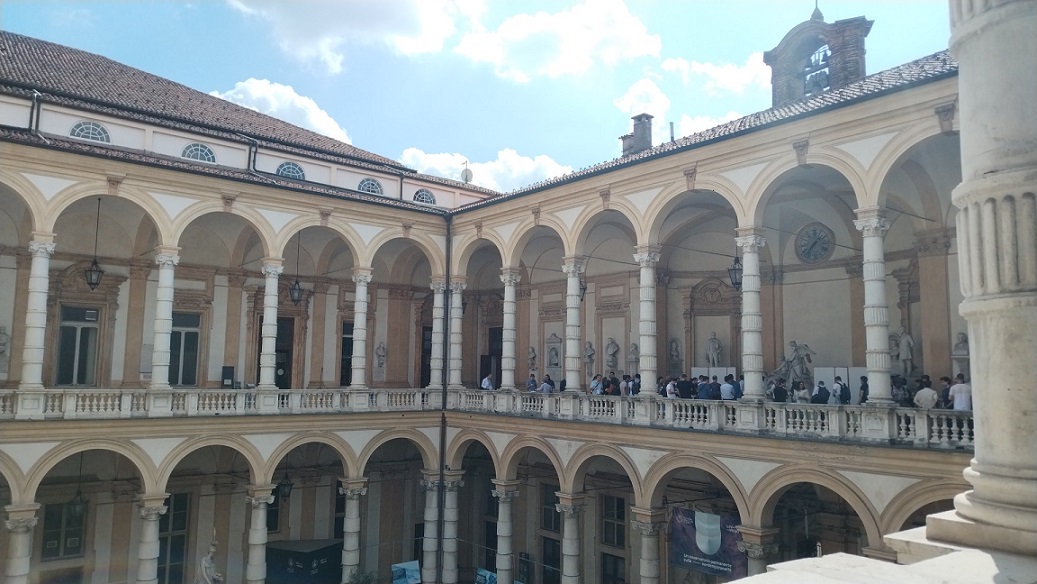
The courtyards of Turin are hidden gems that reveal the city’s most authentic elegance. Behind the understated façades of buildings, mostly Baroque and Neoclassical, lie quiet spaces often adorned with niches, statues, arcades, columns, loggias, and inner gardens.
Even today, Turin’s courtyards retain a discreet charm, far from the bustle of the streets. Exploring these hidden places means discovering the city’s most intimate soul, where architecture, history, and daily life blend harmoniously.
Turin’s Most Beautiful Courtyards
Below we present a selection of Turin’s most evocative courtyards, but as you wander through the city’s streets, you may stumble upon many more hidden behind doors and façades that often appear austere and unassuming.
Some of them are open to the public during business hours; in any case, it is important to respect residents’ privacy, as these are still inhabited spaces.
Palazzo Scaglia di Verrua
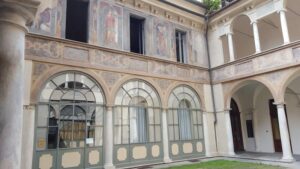 This splendid palace, located at Via Stampatori 4, features frescoes on its façade and in the inner courtyard, painted by the Brescian artist Antonino Parentani in the early 17th century.
The decorations depict allegorical figures and deities, framed within elegant architectural motifs. This type of ornamentation was quite common in Turin between the late 16th and early 17th centuries; however, the extensive urban transformations carried out during the Baroque period have made Palazzo Scaglia the only surviving example of this decorative style.
Palazzo Asinari di San Marzano
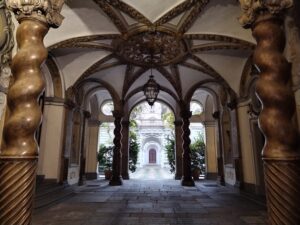 Built in 1684 to a design by architect Michelangelo Garove, this noble palace, located at Via Maria Vittoria 4, was purchased in 1946 by Cavaliere Silvio Turati to serve as the headquarters of the Carpano Company. In 1939, following the extinction of the Carpano family, the trademark of the famous vermouth had in fact passed to Silvio Turati, a member of an important Turin industrial dynasty.
This splendid courtyard, among the most majestic in Turin, is adorned with twisted columns, stuccoes, and statues, and since 1885 has been enriched by a striking Neo-Baroque backdrop.
The University Palace (Rettorato)
Located at Via Po 17 and dating back to the early 18th century, the University Palace’s most striking feature is its inner courtyard (header image of the article), distinguished by a magnificent loggia with two tiers of columns. Beneath the loggia stand dozens of busts and statues commemorating the eminent professors who once taught there. In 1881, Lidia Poët[1] graduated from the Faculty of Law at the University of Turin.
At the center of the courtyard rises an impressive statue of Minerva, symbol of science and wisdom, created in 1858 by the sculptor Vincenzo Vela.
Museum of Decorative Arts
At Via Po 55 stands the Museum of Decorative Arts of the Accorsi – Ometto Foundation, inaugurated in 1999, which preserves the complete collection of the famous Turin antique dealer Pietro Accorsi (1891–1982). It is a house-museum arranged like an aristocratic residence, where furnishings, carpets, tapestries, ornaments, and paintings combine to recreate the atmosphere of the eighteenth century.
From the graceful courtyard, adorned with elegant sculptures, one can glimpse the profile of the Mole Antonelliana, the symbol of Turin.
Palazzo Birago di Borgaro
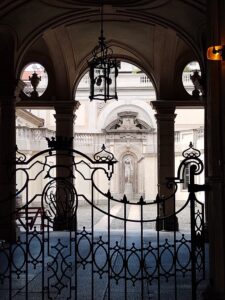 On Via Carlo Alberto 16, a quiet pedestrian street lined with charming bistros and cafés, stands one of the city’s most imposing noble residences, designed by the renowned architect Filippo Juvarra.
The palace faces a gorgeous garden, an inviting green oasis where people can pause, relax, and enjoy a pleasant break in the heart of Turin.
The spacious courtyard of Palazzo Birago di Borgaro features a sumptuous atrium, a scenic backdrop, and a splendid wrought-iron gate, and has housed the Presidency of the Turin Chamber of Commerce since 2000.
When History Meets Contemporary Art
From time to time, several of Turin’s courtyards are transformed into exhibition spaces for contemporary art installations — an inspiring way to showcase and open to the public places that would otherwise remain unseen. Equally fascinating is the dialogue between the historic architecture and the modernity of the works on display.
Some courtyards of Turin have even developed a permanent connection with contemporary art.
Palazzo Villa
The courtyard of this noble palace, accessible from Piazza San Carlo 161 or Via Lagrange, is distinguished by lush vegetation that also grows vertically.
Amid the windows of elegant boutiques stands a striking contemporary art installation — the inverted head of Michelangelo’s David, created by the Italian artist Andrea Salvatori.
The Number 6
According to ArchDaily, the world’s most visited architecture platform, the building known as The Number 6 — named after its street number on Via Alfieri — was awarded the title of Best Renovation Project of 2015.
With the caretaker’s permission, visitors can enter the courtyard, whose clean, geometric lines are enhanced by a stunning light sculpture by the Turin-born artist Richi Ferrero, depicting a tree suspended in mid-air.
If you’d like to explore these architectural treasures — true time capsules of Piedmontese nobility — with a private guide, contact us to arrange a themed tour!
[1] Born in Piedmont, Lidia Poët was one of the first female lawyers in Italy and an extraordinary pioneer for women’s rights. Netflix has recently dedicated a somewhat romanticized series to her life. To learn more about her story and her connection to Turin, read this article.