
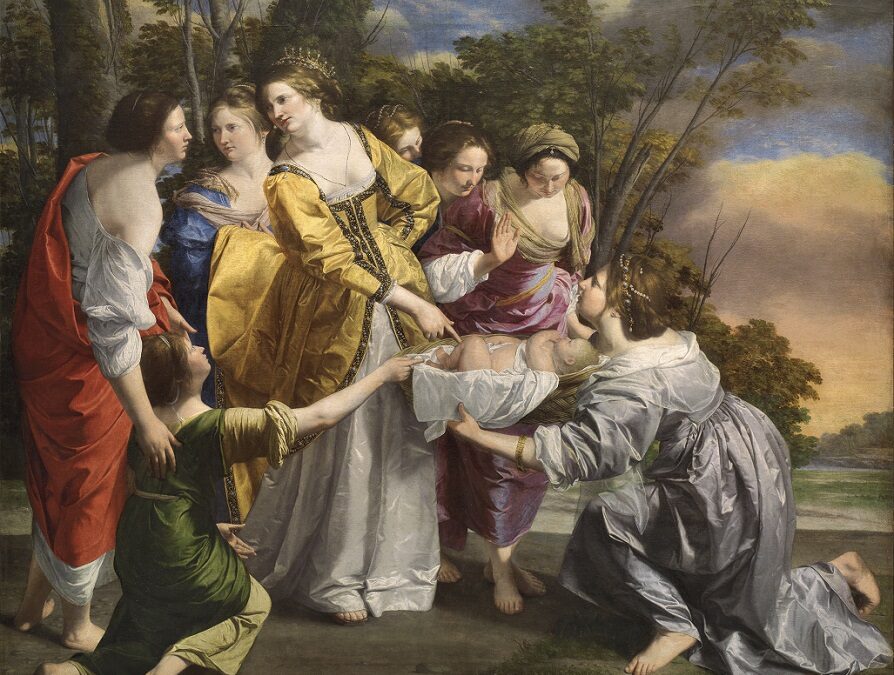
Orazio Gentileschi – The Finding of Moses, 1633 – Madrid, Museo Nacional del Prado
The theme of travel forms the central leitmotif of the exhibition dedicated to Orazio Gentileschi (Pisa, 1563 – London, 1639). The exhibition places the painter’s works in dialogue with those of the artists he encountered during his journeys—from Giovanni Baglione to Guido Reni, Simon Vouet, Antoon van Dyck, and many others—thus offering a rich and dynamic perspective on the European artistic network of the 17th century.
Of Tuscan origin, Orazio Gentileschi worked in several of the major Italian artistic centers as well as at the most important European courts, moving between Rome, Genoa, France, and England.
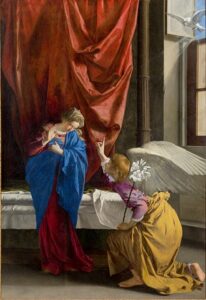
Orazio Gentileschi – The Annunciation – Galleria Sabauda (Musei Reali – Turin)
In an effort to secure the favor of the Duke of Savoy, Orazio Gentileschi sent to Turin in 1623 his large-scale painting The Annunciation, a masterpiece normally housed in the Galleria Sabauda (Musei Reali). Widely regarded as one of the highest achievements of the artist’s career, the work makes an exceptional contribution to this temporary exhibition, on view at Palazzo Chiablese until May 3, 2026.
The exhibition also features a few works by Artemisia Gentileschi, Orazio’s talented daughter. Her personal life, marked by profoundly painful events, had a significant influence on her father’s life and career.
Bringing together more than 40 works, the exhibition is divided into eight sections. The paintings come not only from museums in Turin, but also from religious institutions, private collections, and major public museums, both in Italy and abroad. Among the most prestigious lenders are the Louvre in Paris, the Prado in Madrid, the Vatican Pinacoteca, and the Uffizi Galleries in Florence.
Light, grace, and color are the qualities that define the art of Orazio Gentileschi, a painter of exceptional refinement, admired and very famous during his lifetime, on a par with renowned contemporaries such as Caravaggio, Rubens, and Van Dyck.
Early Years and Roman Influences
The late-Mannerist restraint of his early works gradually gives way to a more naturalistic language, shaped by his encounter with Caravaggio and the circle of his followers.
The artistic milieu of early 17th-century Rome in which Orazio Gentileschi worked was characterized both by rivalries and by stylistic exchanges among painters of different backgrounds. In this regard, the episode of the libel trial brought in 1603 by the Roman painter Giovanni Baglione against Caravaggio is emblematic: Orazio and other painters were involved as supporters of the latter.
Called to testify, Gentileschi revealed his association with Caravaggio, also confirmed by the exchange of objects useful to their artistic practice. He recounts, for example, having lent his colleague a pair of stage wings and a Franciscan habit to be used as models for his paintings.
Across Europe: At the Courts of France and England
Summoned by Queen Mother Marie de’ Medici in 1625, Orazio traveled to France, where he spent about a year. From his Parisian stay, the exhibition presents the canvas entitled Public Felicity Triumphing over Dangers, on loan from the Louvre, which highlights the artist’s skill in the detailed rendering of fabrics.
It is therefore unsurprising that the renowned Italian art historian Roberto Longhi described Orazio Gentileschi as “the most marvelous tailor and weaver ever to work among painters,” praising his extraordinary ability to render textiles and drapery with precision and elegance, and to transform painting into a true “tapestry” of light and material.
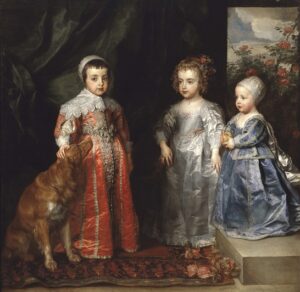
Antoon Van Dyck – The Three Eldest Children of Charles I of England – Galleria Sabauda (Turin).
From the French court, Orazio—now at the height of his maturity—traveled in 1626 to the court of Charles I of England, where he met the famous portraitist Antoon van Dyck, already in the king’s service. From this period, the exhibition presents the splendid portrait by the Flemish artist entitled The Three Eldest Children of Charles I of England, one of the masterpieces from the Galleria Sabauda in Turin.
Also dating from this same period is The Finding of Moses, normally housed at the Prado Museum and exhibited in Italy for the first time (header image at the top of the article).
Hoping ardently to return to Tuscany, Orazio remained in London until his death on February 7, 1639.
If you would like to explore the works and key stages of Orazio Gentileschi’s artistic journey in a clear and engaging way, do not hesitate to book your guided tour!