

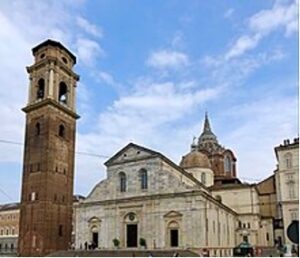
 The so-called Shroud of Turin, a burial cloth over 4 meters long, is one of the most significant and enigmatic religious artifacts in the world. This relic bears the imprint of a crucified man, widely believed by Christians to be Jesus Christ. It is currently housed in the Cathedral of Turin (or Duomo di Torino), the capital of the Piedmont region in northern Italy.
In 1452, the Holy Shroud became the property of the Royal Family of Savoy. At that time, the Dukes of Savoy resided in Chambéry, which now belongs to France. In 1578, the relic was moved to Turin, the new capital of the Duchy of Savoy, marking the beginning of its long association with the city.
To shelter it in a dignified manner, a masterpiece was created: the Royal Chapel of the Holy Shroud, designed by the Baroque architect Guarino Guarini. This chapel can now be visited by accessing it from the Royal Palace, while the relic is kept inside a specially designed shrine in the cathedral.
In 1983, the last King of Italy, Umberto II, bequeathed the relic to the Holy See on the condition that it would remain in Turin.
For various reasons, the Shroud of Turin is seldom displayed. Public exhibitions of this relic are significant events for the city, requiring careful planning well in advance. These exhibitions do not occur at regular intervals. The most recent public exhibitions were held in 1978, 1998, 2000, 2010, and 2015. The Pope and the Cardinal of Turin set the dates for each new exhibition, but currently, there is no official schedule for the next display.
Shrouded in Mystery: The Ongoing Debate
 The Shroud of Turin is one of the most fascinating and debated religious artifacts in history, investigated by scientists, historians, and theologians. It draws attention from both the faithful and the curious.
Although new studies on its authenticity are continuously conducted, the big question mark remains about what truly happened to the Shroud before becoming the property of the House of Savoy. Whatever one may think about it, what is most astonishing is that there are no traces of pigments on the linen. This means that the image of the man visible on the cloth was not painted or created by human hands.
For those interested, the Museum of the Shroud (Italian: Museo della Sindone) in Turin offers engaging exhibits that delve deeper into the mystery of the Shroud.
The Church of the Holy Face in Turin
 Located outside the city center, in a former industrial area, the Church of the Holy Face (Italian: Chiesa del Santo Volto), designed by contemporary Swiss architect Mario Botta, is a modern tribute to the Shroud of Turin.
In fact, one of the most intriguing features of this church is the installation behind the main altar, which evokes the image of the man visible on the Shroud. This artistic creation resembles the pixels of a digital image, achieved through a particular arrangement of marble.
If you are eager to learn more about the Shroud of Turin and its fascinating history, book a themed guided tour with us.