
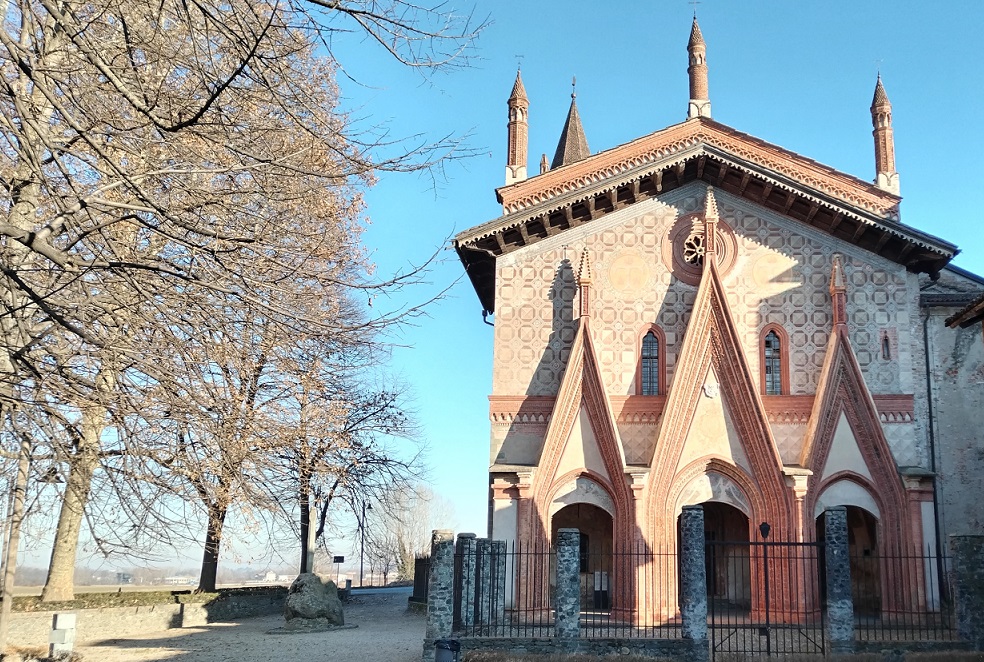
The so-called Precettoria Saint Anthony of Ranverso is a true gem of Piedmontese Gothic architecture. Although less well-known than the Sacra di San Michele, also located in the Susa Valley, it is absolutely worth a visit.
Around 1185, the abbey was founded thanks to a donation by Count Humbert III of Savoy and entrusted to the congregations of the Antonines. These dedicated themselves to the care and assistance of pilgrims traveling along the Via Francigena, an important route connecting central and northern Europe to Rome, the capital of Christendom. They belonged to the Order known as the Hospital Brothers of Saint Anthony.
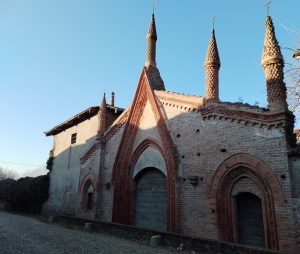 Moreover, adjacent to the abbey, a hospital was built to serve as a sanctuary for those in need. Here, the brothers primarily treated individuals afflicted with ergotism, also referred to as “St. Anthony’s Fire” (ergotism). To alleviate the painful wounds caused by the disease, they used pig fat.
This explains why Saint Anthony the Great, also called St. Anthony the Abbot or St. Anthony of Egypt, is almost always depicted alongside a pig. Furthermore, the terracotta decorations adorning the facades of both the church and the hospital are embellished with motifs of acorns, symbolizing the food provided for these animals.
The Interior of the Church
Behind the the main altar one can admire a majestic polyptych, a masterpiece by Defendente Ferrari of Chivasso, a painter active between 1497 and 1531. This work of art was commissioned by the residents of Moncalieri, a suburb of Turin, and gifted to the Precettoria in 1531 as a token of gratitude for the end of the plague. In its gilded wooden architectural frame, the central scene depicts the Nativity of Christ, surrounded by numerous figures of saints.
Additionally, most of the frescoes inside the church date from the first half of the 15th century and are the works of Giacomo Jaquerio, a court painter to the Acaja family, a cadet branch of the House of Savoy.
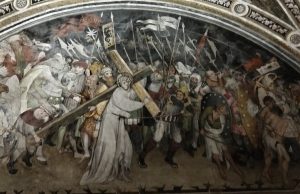 Particularly impressive is the fresco entitled “The Ascent to Calvary”, located on the north wall of the former sacristy. Christ stands as the central figure in this vibrant and powerful scene. On the left, a group of devout women, including Veronica, initiates the composition, which unfolds to include a multitude of other figures. The intricate details of the clothing, combined with the physical and psychological depth of the characters, contribute to making this monumental painting exceptionally vivid and striking.
An Artistic Gem in a Peaceful Setting
Indeed, Saint Anthony of Ranverso is an oasis of peace and a true artistic gem. My past experiences show that this place always enchants its visitors.
Contact us to plan your excursion to the Susa Valley and discover the beauty of this exceptional location.