How does the Piedmontese dialect sound? Piedmont, like every Italian region, boasts its own dialect: Piedmontese.
Dialects in Italy can differ significantly, and the contrasts are especially noticeable when compared to standard Italian. For instance, the dialogues of Massimo Troisi, internationally known for his role in the iconic film Il Postino (The Postman) with Philippe Noiret, are incomprehensible to many Italians from the north.
What Sets the Piedmontese Dialect Apart from Other Italian Dialects?
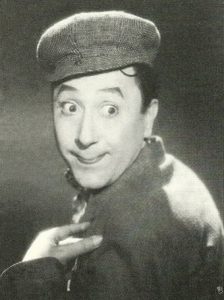
Erminio Macario (photo: Commons Wikimedia public domain)
The Piedmontese dialect bears a remarkable resemblance to French, which is no surprise given the region’s historical ties to France and its proximity to the country. I recall an anecdote of a young Piedmontese man who faced a technical problem in France. Without much effort, he was able to acquire what he needed—a screwdriver (“tornavis” in Piedmontese… tournevis in French!).
In Italy, the Piedmontese dialect has a reputation for being “provincial”. It is often associated with personalities from the entertainment world, such as Macario (1902–1980), the beloved actor and comedian from Turin known for his work in theater, film, and television.
How to Recognize Piedmontese Words
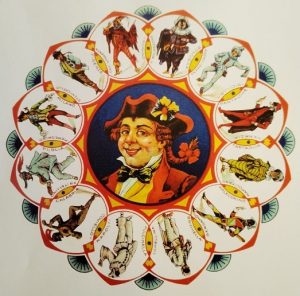
Gianduja, the carnival mask of Piedmont, surrounded by other masks from all over Italy. Photo: Confetteria Stratta
In Turin and across the Piedmont region, there are often unfamiliar words for those who know standard Italian. For example, restaurant names like Osto del Borgh Vej (the inn of the old neighborhood) in Turin or wine producers such as Ghëddu in La Morra use Piedmontese words.
The Italian alphabet only includes 21 letters (no J, K, X, Y, W), and there’s no umlaut in standard Italian. Therefore, words with a “j,” an umlaut, or ones that don’t end in a vowel are indicators that the word is Piedmontese.
Key Expressions in Piedmontese
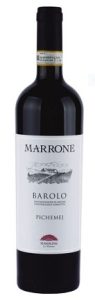 Here are some essential words/expressions to better understand the Piedmontese spirit.
- Esageruma nen! (Let’s not exaggerate!): This is the motto of the Piedmontese, who generally don’t like to boast or indulge in ostentation.
- Neh (isn’t it?): used at the end of a sentence to confirm the statement.
- Pi che mej (more than better): it’s the equivalent of “the best,” as wine producer Agricola Marrone decided to name his favorite Barolo.
- Ghëddu: While difficult to translate into a single word, it represents the personal and authentic style one can bring to any activity.
In Turin, it’s rare to hear someone speaking in Piedmontese, but venture outside the main city, and you’ll find the dialect spoken in local markets and towns throughout the region.
To immerse yourself further in the rich heritage and culture of Piedmont, consider booking a private guided tour. Our highly informative, yet entertaining, tours offer you the chance to explore this unique region while learning about its customs and traditions.